

cognitionstudio.com Practices Science Communications Venture Design One Health
Cognition Science Communications
Our Expertise How We Work What We Build Case Notes Start a conversation →
Home / Case Notes / Adaptive · KnowMRD disease-state education

How a first-in-class NGS diagnostics company built clinical belief in a new category of cancer testing

A clinical community moved from not knowing what MRD was to understanding it, trusting it, and acting on it. That belief shift is what a new diagnostic category needs before it can become routine care.

Challenge Building belief in a new diagnostic category
Domain NGS-based MRD · hematologic malignancies
Stage Commercial-stage diagnostics
Audience KOLs · heme-onc · early adopters
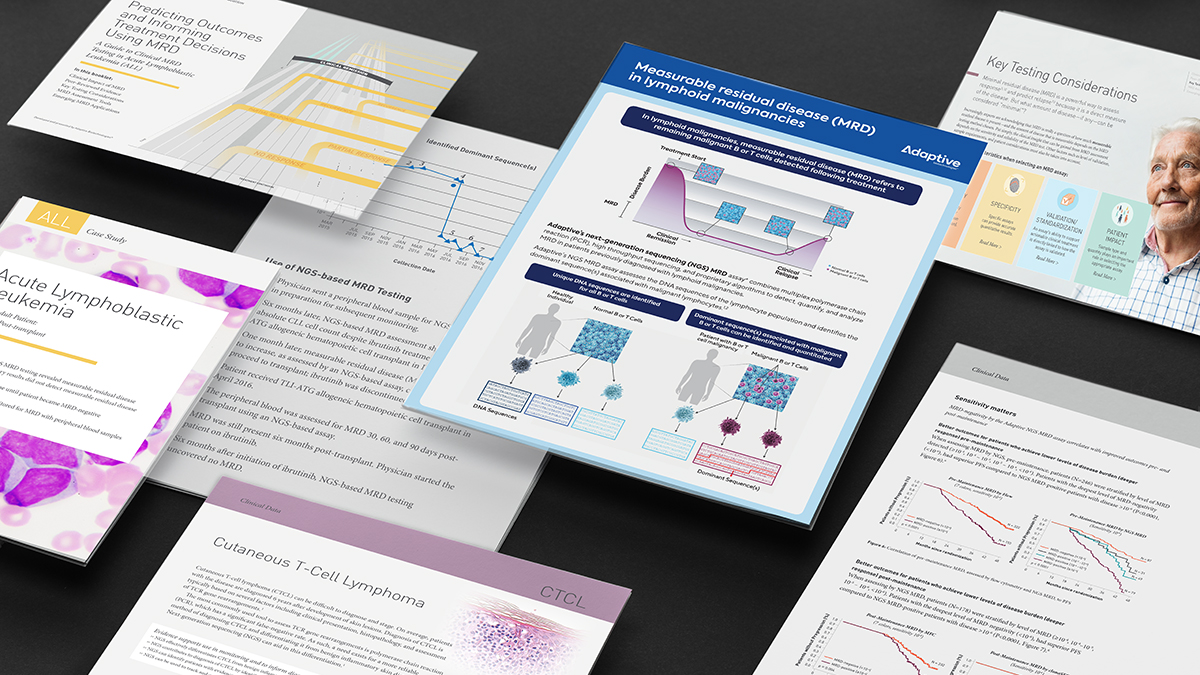
A spread from the unbranded KnowMRD disease-state education curriculum — History and Clinical applications of measurable residual disease
The unbranded KnowMRD education system — the work that made a new diagnostic category legible.

The Science

MRD is the small population of cancer cells that survives treatment, below the detection limit of standard response assessment. clonoSEQ uses multiplex PCR and next-generation sequencing to identify the DNA signature of a patient's malignant clone at diagnosis, then tracks those exact sequences in later samples, detecting one cancer cell among a million.

It reframes what response means: not whether disease is visible, but how much remains. In 2018 it became the first FDA-cleared NGS MRD assay for any lymphoid cancer.

Identified Dominant Sequence(s) chart — an NGS MRD assay tracking a patient's malignant clone across serial blood and bone-marrow samples
Tracking a patient's dominant clone across serial samples — NGS-based MRD reframes response as how much disease remains, not simply whether it is visible.

The Challenge

The science was sound; the belief wasn't there.

In 2018, physician research found limited belief that MRD was clinically actionable — many community hematologists didn't know the term, and even MRD testers couldn't say how a result should change a decision. MRD faced the classic new-category trap: guidelines lagged, reimbursement lagged, and clinicians defaulted to the tests they knew. For a first-in-class diagnostic, the barrier wasn't proving the assay worked. It was making an entire field understand what MRD was, believe it mattered, and know what to do with it.
The Work

The strategy was behavioral, not promotional: educate, motivate, engage.

We built the unbranded education system — KnowMRD — that moved the field along an adoption continuum. A systems-mapping Knowledge Journey workshop charted the forces holding MRD back — status quo, cost fear, unclear guidelines — and the virtuous cycle that could replace them, then fixed a near star grounded in the Health Belief Model: clinicians understand MRD and believe its status matters, so that they act on it.

From that spine we produced a complete curriculum across the hematologic landscape — clinical data summaries, disease-state brochures spanning six malignancies, case-based studies, and bibliographies across nine disease areas — all unbranded, so the science, not the product, did the teaching.

The MRD detection landscape — microscopy, flow cytometry, PET/CT, ASO-PCR and NGS assessment methods
The MRD detection landscape — from microscopy to NGS — mapping where a new category of testing fits.

The Outcome

Education didn't make the science true. It made the science adoptable.

The category the unbranded program was built to establish took hold. MRD moved from an acronym community physicians didn't recognize to a concept embedded in NCCN and ELN guidelines and reimbursed by Medicare across multiple malignancies. The belief that was missing in 2018 — that MRD is clinically actionable — became the field's default.

12–0
In 2024, the FDA's advisory committee voted unanimously to accept MRD as an endpoint for accelerated drug approval in multiple myeloma.
Guidelines
MRD embedded in NCCN and ELN guidelines — the reference points clinicians actually follow.
Reimbursed
Covered by Medicare across multiple malignancies — adoption backed by payment, not just awareness.

Cognition built the unbranded education system that made the category legible; guideline, reimbursement and regulatory milestones are the field's, driven by many contributors alongside the science.

The takeaway

A category-defining diagnostic stalls until the field believes in it. Regulatory clearance proves an assay works; disease-state education makes a field adopt it, and the gap between the two is where a new standard of care is won or lost.

Related proof

The same craft, other rooms.

See the capability →
Efzofitimod — structural rendering of the engineered Fc-fusion protein
Sarcoidosis · SVP

Turning a missed endpoint into a focused, data-defined clinical case.

eGenesis Brand Strategy — navigating the landscape of xenotransplantation
Xeno · SVP

Turning a fear narrative into the medical-innovation story the field now tells.

Have a category the field doesn't believe in yet?

Start a conversation →
Explore