
cognitionstudio.com Practices Science Communications Venture Design One Health
Cognition Science Communications
Our Expertise How We Work What We Build Case Notes Start a conversation →
Home / Case Notes / Pacira · PCRX-201 science value proposition

How a non-opioid pain company built the narrative that made gene therapy credible for a common disease

With its narrative in place, Pacira could make its case: a non-opioid gene therapy that treats knee OA at the source, and the platform to bring that approach into common disease.

Challenge Owning the narrative for a novel gene-therapy platform in common disease
Domain Non-opioid pain · gene therapy · knee OA (IL-1)
Stage Clinical-stage · in-license → acquisition · Ph 1 → Ph 2
Audience HCPs, KOLs · investors & partners

PCRX-201 (enekinragene inzadenovec) is investigational and has not been approved by any regulatory agency.

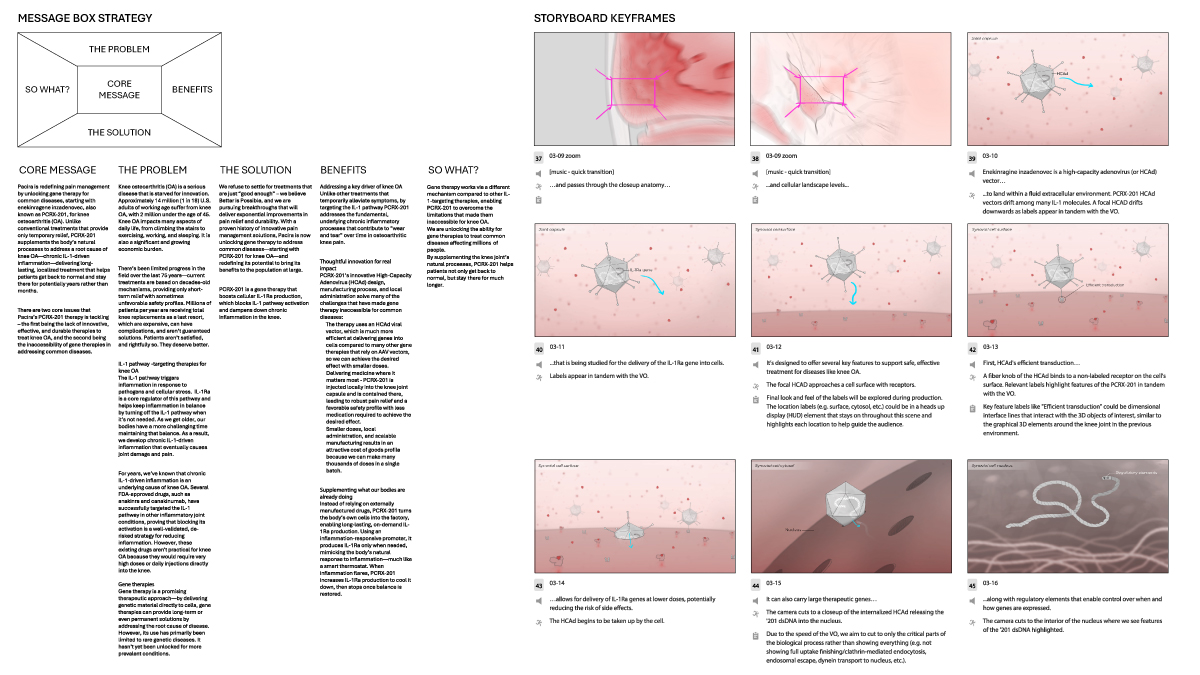
A message-box strategy — core message, the problem, the solution, benefits and 'so what?' — with storyboard keyframes for the PCRX-201 3D mechanism-of-action animation.
The message strategy and storyboard at the center of the PCRX-201 narrative Pacira now owns.

The Science

For knee osteoarthritis (OA), non-opioid options only mask pain, and the only anatomical way to remove it is total knee replacement, the endpoint Pacira set out to disrupt. PCRX-201 (enekinragene inzadenovec) is an investigational gene therapy designed to treat the cause: chronic IL-1 signaling in the joint.

A single injection delivers the IL-1Ra gene via a high-capacity adenoviral vector with an inflammation-responsive promoter that produces IL-1Ra only when signaling rises and stops as signaling resolves. Self-regulating and locally contained, it maintained pain and function gains from one dose in a Phase 1 study. The technology is the product.
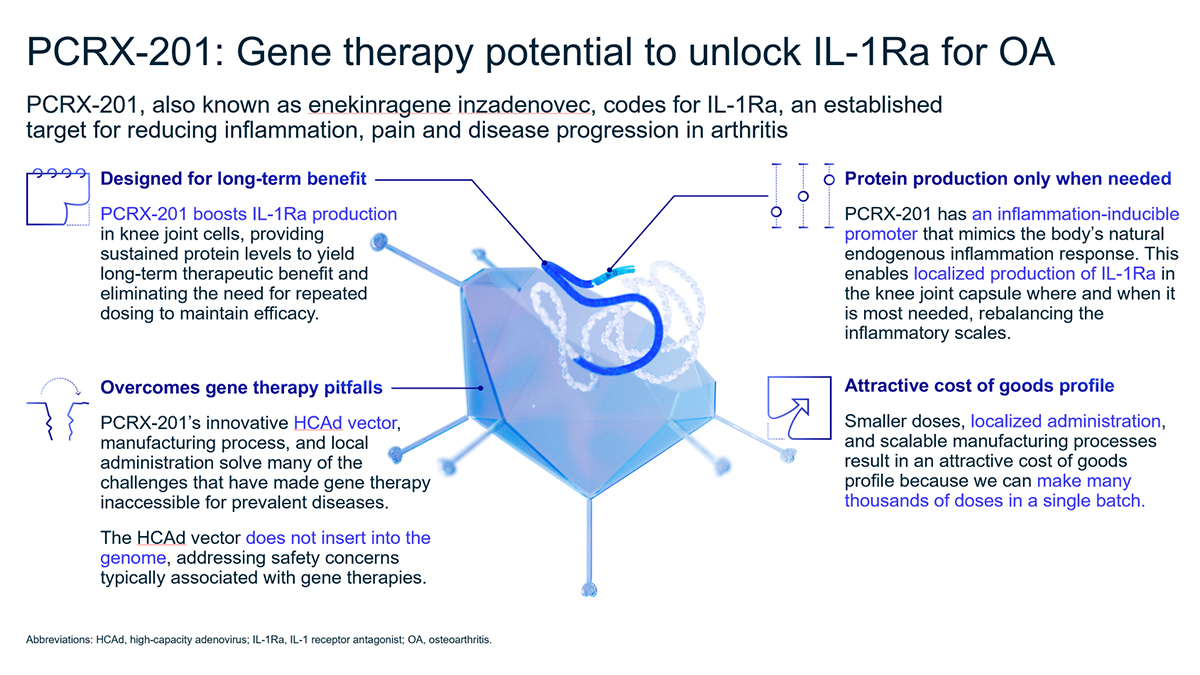
PCRX-201 (enekinragene inzadenovec) codes for IL-1Ra to reduce inflammation, pain and disease progression in arthritis: designed for long-term benefit, protein production only when needed via an inflammation-inducible promoter, overcomes gene-therapy pitfalls with a non-integrating HCAd vector, and an attractive cost-of-goods profile.
How PCRX-201 works — a non-integrating HCAd vector delivers the IL-1Ra gene under an inflammation-inducible promoter, producing IL-1Ra locally in the knee only when it is needed.

The Challenge

What if gene therapy could treat a common disease, not just a rare one?

Pacira asked a question the field had avoided. Answering it meant taking a high-capacity adenoviral (HCAd) platform from in-license to full acquisition, and choosing knee OA — a serious and under-innovated disease whose burden and unmet need for durable pain relief keep growing.1 But a novel platform is easy to mishear, and the lead asset was heading into ACR Convergence, the moment the field would take its measure. Medical and investor audiences had to grasp what the technology was worth before they could back it.
The Work

We wrote the story Pacira now owns.

Cognition built the message platform and wrote the narrative that carried it. Using our Science Value Proposition approach, and the COMPASS Message Box2 to structure it, we started from the value rather than the mechanism: why a self-regulating gene-therapy platform, given as one local injection, was worth believing in for a common disease.

We framed the problem, why it mattered, and what set the technology apart, then wrote it into a message house, a press narrative, and the FAQs the whole company could speak from. O ne voice across medical and investor audiences. Clear visuals and a nearly four-minute 3D animation supported the written case, but the argument was made in words first.

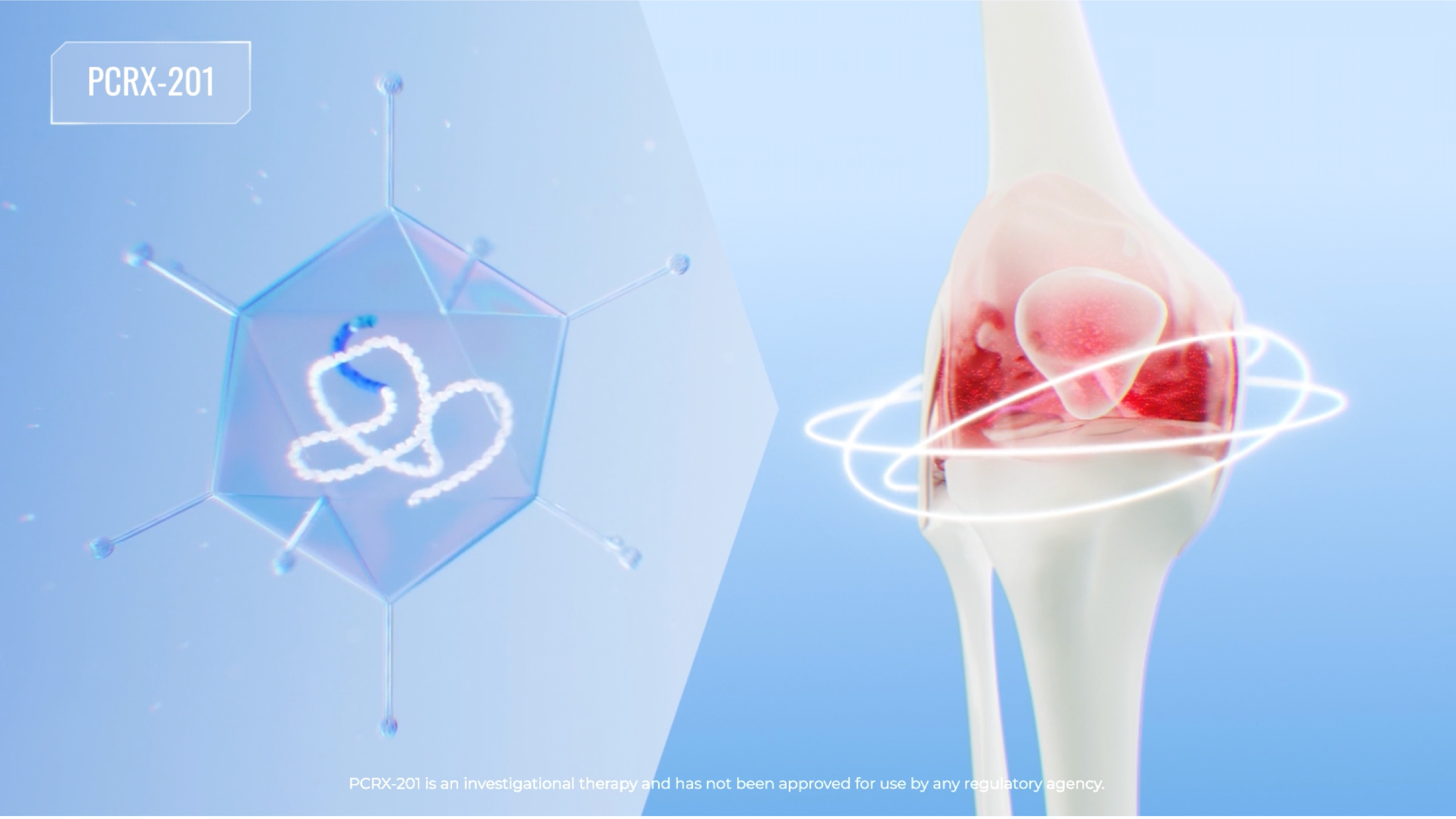
PCRX-201 — a high-capacity adenoviral vector carrying the IL-1Ra gene, shown beside the knee joint it is injected into to rebalance inflammation.
A frame from the 3D mechanism-of-action animation the platform produced — the PCRX-201 vector and the knee joint it rebalances.

The Outcome

The first to carry gene therapy from rare disease into everyday pain.

The science communication platform became the language, setting the tone for how Pacira explains PCRX-201 today across its medical and investor communications. It gave the company a position to own: the first to carry gene therapy from rare disease into everyday pain. What began at a single congress scaled into an always-on layer that keeps teaching medical audiences a new class of therapy.

RMAT + ATMP
PCRX-201 is the first and only knee-OA gene therapy to hold FDA RMAT and EMA ATMP designations.
A position to own
The first to carry gene therapy from rare disease into everyday pain — the narrative Pacira now owns.
Always-on
What began at a single congress scaled into an always-on layer that keeps teaching a new class of therapy.

PCRX-201 (enekinragene inzadenovec) is investigational and has not been approved by any regulatory agency.

The takeaway

When a technology is new, its value is not self-evident. Someone has to write it. Own that narrative early and you own the position, before the data, the market, or a competitor writes it for you.

References

  1. 1 OA burden and unmet need: OARSI White Paper, Osteoarthritis: A Serious Disease (2016); A National Public Health Agenda for Osteoarthritis, 2020 Update (Osteoarthritis Action Alliance, CDC, Arthritis Foundation); FDA Voice of the Patient, Osteoarthritis (2017).
  2. 2 Method: Baron N. Escape from the Ivory Tower (Island Press); the Message Box, COMPASS (compassscicomm.org).

Related proof

The same craft, other rooms.

See the capability →
eGenesis Brand Strategy — navigating the landscape of xenotransplantation
Xeno · SVP

Turning a fear narrative into the medical-innovation story the field now tells.

Efzofitimod — structural rendering of the engineered Fc-fusion protein
Sarcoidosis · SVP

Turning a missed endpoint into a focused, data-defined clinical case.

Have a first-in-class asset whose value needs arguing?

Start a conversation →
Explore